
Search Results



Barry Holt interview, February 11, 1977: transcript
On February 11, 1977, collector Lee LaVecchia interviewed Barry V. Holt (born January 20th, 1946 in Las Vegas, Nevada) at his home in Las Vegas, Nevada. In the interview, Mr. Holt speaks about the differences between growing up in Las Vegas in the fifties and sixties compared to how his children are growing up at the time of the interview. He also discusses education and the religious community in the city.
Text

Jack L. Monroe Jr. interview, March 15, 1981: transcript
On March 15, 1981, Marie Carmichael interviewed Jack L. Monroe Jr. (b. 1937 in St. Helena, California) about his life in Las Vegas, Nevada and his work as a cook among many other topics. Monroe speaks initially about his time working alongside his family in the restaurant business, with his father working as a cook, his mother a waitress and himself as both a busboy and a cook. He discusses the working conditions of cooks, the competition between casino restaurants and the relationship between workers, bosses and the public. Moreover, Monroe speaks about life in Las Vegas as a youngster, the significance of YMCA, summer camps and other recreational activities, and the school system. Lastly, he talks about the changing infrastructure of the city, the paved roads and public transportation, how casinos made their profits and the attachment residents develop towards the city of Las Vegas.
Text

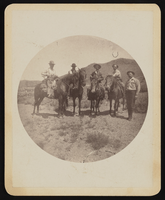
Five unidentified men with horses in Candelaria (Nev.): photographic print
Image
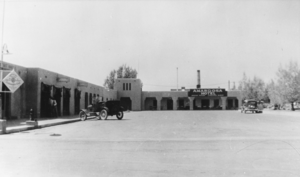
Amargosa Hotel, Beatty, Nevada: photographic print
From the Nye County, Nevada Photograph Collection (PH-00221) -- Series III. Beatty, Nevada -- Subseries III.H. Miscellaneous
Image

Newsletter clipping honoring College of Southern Nevada Foundation Legacy of Achievement Award Honoree Theron Goynes, circa 2010
Newsletter clipping honoring College of Southern Nevada Foundation Legacy of Achievement Award Honoree Theron Goynes, circa 2010. A clipping taped to the title reads "Theron & Naomi Goynes Education Scholarship."
Text


Transcript of interview with Maxwell Kent "Tim" Hafen by Stefani Evans and Claytee White, September 14, 2016
With so much emphasis put on the growth of Las Vegas and Henderson over the past thirty years, we often forget about the development of the others cities in the Valley. Expansive growth in Southern Nevada in the mid-twentieth century shows the region being one of the last bastions of agricultural existence, and Tim Hafen has been a major player in the development of the city of Pahrump. Born in St. George, Utah, and raised in Mesquite, Nevada, he graduated from Virgin Valley High School and attended Dixie College. Before the Bureau of Land Management (BLM) was called as such, his father introduced him to the working of the land through dairy and hay farming, where a young Tim decided he would never milk a cow again. His rejection of cow milking didn’t deter him from following the influence of his father after he married his wife, Eleanor, in 1951 and moved to Pahrump to become a cotton farmer. At that time, there were only 150 people in the area with a third of the population being from the Paiute tribe. Once the city was incorporated in 1964, he founded the Pahrump Valley Utility Company to get electricity to the area along with Amargosa Valley. Top crops at the time included cotton, alfalfa as well as wheat that were picked by Mexican farm laborers used under a yearlong contract with the Bracero program. vi In this interview, Hafen shares how he began his career in politics from getting called for grand jury in 1963. From 1966–1974, he was a member of the legislature, where he served two terms in the Old Capital building and held various positions such as Chairman of the State Board of Agriculture for twelve years and President of the Nevada Farm Bureau. He was speaker pro tem and Chairman of the taxation committee and decided to call it quits because of the Nixon scandal. Between 1974 and 1975 Hafen ended his political career, which he did before brothels began to come to the area later in the decade. In 1982, in the wake of the gasoline crisis, Hafen, like other Pahrump cotton farmers, could not afford to continue farming; he decided to shift from farming to development. His first development done was Cottonwoods at Hafen Ranch, which was on 160 acres of alluvial fan, non-farmable land; in 2000 he opened his second subdivision, Artesia at Hafen Ranch.
Text