
Search Results

Transcript of interview with Eva Garcia Mendoza by Elsa Lopez and Barbara Tabach, September 25, 2018
On the corner of 7th street and Clark, and beside the tennis courts of Las Vegas Academy, stands the law office of attorney Eva Garcia Mendoza. Eva has worked in her office since 1982, and in this time she has helped the Las Vegas community work through civil and immigration cases besides aiding in a myriad of other ways. Eva Garcia Mendoza was born in 1950, in the town of McAllen, TX-an environment that perpetuated hatred of Mexican Americans. Eva recalls the racism she endured; for instance, being spanked if she spoke Spanish in school, and her family facing job discrimination because of her skin color or her last name. Being an ethnic and financial minority was difficult, and Eva remembers nights as a child when she would cry herself to sleep. Eva showed resilience in the face of adversity as she states, “you rise to the level of your teachers’ expectations.” With the encouragement of her band professor, Dr. L.M Snavely, she began higher education at Pan American College. She moved to Las Vegas in 1971 and began to work before being accepted at UNLV to study Spanish literature. She graduated in the class of 1973. In 1975, Eva applied to become a court interpreter, a decision that would drastically change the trajectory of her career. She earned the coveted position and began to work beside Judge John Mendoza who was the first Latino elected to public office in the state of Nevada. Several years later John and Eva would wed. Judge Mendoza passed away in 2011. Eva talks about how extraordinary his legacy is-from his professional achievements to a story about his v football days and the 1944 Dream Team, this true story even piqued the interest of Hollywood writers. Through her work, Eva began to notice how she was more than qualified to become a lawyer herself, so she applied and gained a full ride scholarship to the Law School of San Diego University. Eva describes the struggles of attending school in San Diego while her spouse and children were home in Las Vegas. Despite the financial difficulties, being one of few minority students, and becoming pregnant her second year, Eva was able to finish her remaining university credits by returning to Las Vegas and working with Judge Mendoza. Together, they started the Latin Bar Association. Eva began her own practice in 1981 and would later partner with Luther Snavely, who was the son of her band teacher that helped her to attend college so many years back. Today, Eva has a new partner at her office and hired her son to work as a secretary. Eva also tells of the office’s mysterious history, of which includes a ghostly figure many clients claimed to have seen in the reception room. Eva recounts many of her professional achievements, such as petitioning to start the American Immigration Lawyers Association, Nevada Chapter, representing celebrities, winning the unwinnable cases such as against the Nevada Test Site. Eva talks about current events, such as today’s immigration laws, the discriminatory practices of revoking birth certificates from those born in Brownsville, TX., and about the importance of the #MeToo movement. Eva and her family have a great fondness for Las Vegas. The support for the Latinx community in Las Vegas greatly contrasts that which she experienced as a child in southern Texas. She describes wanting to take her children and grandchildren to visit her old home in McAllen, TX where her family grew up on the “wrong side of the tracks.”
Text

Transcript of interview with Peter Perazzo by Claytee White, July 22, 2016
Peter Perazzo, a land surveyor born and raised in Las Vegas, talks about his family, his Native American ancestry, and how construction and land surveying have changed over the years. Peter’s father, Frederick Perazzo, moved temporarily to Las Vegas from Reno in the 1940s to find employment. He worked as a draftsman, and later an architect. He designed public building and residential buildings around the valley as well as at Area 51 (Atomic Test Site). His temporary move became permanent in 1953 with the purchase of a family home in Northwest Las Vegas, across from Twin Lakes. Peter’s early life was spent playing in clover in the family’s yard and enjoying his four grandmothers. Peter began his land surveying career working for the Bureau of Land Management (BLM) in 1985. He describes how he became hooked on the profession and describes surveying terms like monuments, townships, and “the dumb end of the tape”. Later Peter worked for the Nevada Department of Transportation, where he wa
Text

Transcript of interview with Patricia Ross by Judy Harrell, March 19, 2014
Patty Ann Drew’s life experiences capture large movements in Las Vegas history: mob-dominated gambling, the Helldorado Rodeo, explosive growth, medical advances, and Clark County School District’s Sixth Grade Centers—all in a desert city centered in the Mormon Culture Region. Patty arrived in Las Vegas as an infant with her parents and older brothers in 1944 and was raised in the Huntridge area, where she and her brothers attended John S. Park Elementary School and matriculated from there to Las Vegas High School. In this interview, Patty talks about her parents working on the Strip, her school days, joining the Church of Jesus Christ of Latter-day Saints, marrying her high school sweetheart, and becoming a young mother in Las Vegas. After Patty married her second husband, Thomas Ross, the couple built a house west of Jones Boulevard and Patty gave birth to her third son. In addition, she returned to school to earn her Bachelor’s and Master’s degrees and taught at C. H. Decker Elementary School for twenty years.
Text
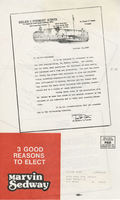
Marvin Sedway campaign materials, item 01
3 Good Reasons to Elect Marvin Sedway mail send-out
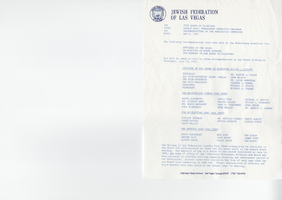
Jewish Federation correspondence, meeting minutes, and other records, item 37
A letter to the Jewish Federation of Las Vegas Board of Directors from Gerald Welt, the Nominating Committee Chairman, May 6, 1991