
Search Results
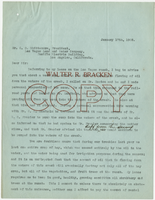
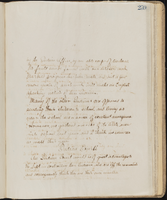
Letter from Walter R. Bracken to C. O. Whittemore (Los Angeles), January 17, 1908
Letter to the president of the Las Vegas Land and Water Company complaining of the railroad pumping oil from a sump into Las Vegas Creek.
Text
Alan King recordings, 1979 to 1980
King answers call-in questions from listeners, talking about comedy, his views on the LGBT community, his twenty-year friendship with Renee Richards, his concerns about nuclear energy, politics, the energy crisis, and other topics.
Collection Name: Arnold Shaw Interviews and Performance Recordings
Box/Folder: Digital File 00
Archival Component
John Pellissier oral history interview, 2025 February 24, 2025 March 24
Oral history interview with John Pellissier conducted by Claytee D. White and Stefani Evans on February 24, 2025 for the Game On! The Oral History of Las Vegas Sports project. In this interview, Pellissier talks about growing up in Las Vegas, spending his formative years driving in the desert with his father, which grew into attending off-road races with his uncle and dirt biking with his cousins. He got involved in off-road racing as an adult, which led to him getting involved with S.N.O.R.E., where he has now spent over a decade being involved on the Board of Directors in various positions. He has been the Sergeant at Arms, Vice President, and is the current President. He speaks about the environmental impact for both racers and wildlife, and how the Bureau of Land Management has not always been supportive of desert racing. He has learned how to effectively 'lobby the hobby' and make sure that we continue to protect the environment, while still giving off-road racing a chance to thrive. He speaks about S.N.O.R.E. reaching 56 years of consistent operation as a non-profit, and how he hopes to see the group continue to grow and put on more races in the desert.
In the second interview with John Pellissier conducted by Stefani Evans and Bethany Dayton on March 24, 2025, Pellissier talks in detail about the Mint 400 race and its history and growth. The race originally ran from the Mint Hotel, into the desert, and through Moapa. After land and permit issues arose, the race was moved to be closer to the Speedrome (now Las Vegas Motor Speedway) and through Jean. While he was President of S.N.O.R.E., Pellissier and other board members did research and found that the copyright for the Mint 400, originally owned by Norm Johnson, was available, and made the decision to purchase the rights for $20,000. S.N.O.R.E. put on their first Mint 400 race in 2008, running the original track through Moapa. It was a huge success and they were able to run the race for two more years, moving to the Jean track after the first year. With the newfound success, S.N.O.R.E. was not able to keep up with what the Mint 400 now demanded, and decided to sell the copyright to Josh and Matt Martelli. He speaks about his hope for the future of the Mint 400, and says it will continue to be the biggest off-road race in North America, save the Baja 1000. Digital audio and transcript available.
Collection Name: Game On! The Oral History of Las Vegas Sports Interviews
Box/Folder: Digital File 00
Archival Component
Transcript of interview with Irwin Molasky by David G. Schwartz, April 23, 2014
Interview with Irwin Molasky by David G. Schwartz, April 23, 2014. In this interview, Irwin Molasky discusses arriving in Las Vegas in the 1950s, and building the Pyramids motel on the Strip. He talks about the entertainers in various hotels on the Strip, the concept of the "star policy," and bringing Parisian shows to Las Vegas. He goes on to discuss his real estate developments, including Paradise Palms, Boulevard Mall, and Sunrise Hospital, and donating the land for the development of UNLV.
Irwin Molasky came to Las Vegas in 1951, during a time when "everyone knew everyone else," and there was a small, but strong Jewish community. An Army veteran, Irwin and his wife moved to Las Vegas after living in California for a short time. Irwin soon built The Pyramids, a Strip motel next to the Flamingo Hotel and Casino. The Pyramids opened the same day as its northern next-door neighbor, The Sands Hotel and Casino, on December 15, 1952. Irwin used his newly acquired contractor's license to become on the city's most important real estate developers. Over the next 60 years, he built everything from residential housing, including Paradise Palms to commercial properties. Projects included Sunrise Hospital and the surrounding medical buildings; Sunrise City Shopping Center and other power centers; Bank of America Plaza and much other downtown development; and golf courses. When the recession hit, Irwin began bidding on government projects across the country, successfully shielding his business and employees from the economic downturn. Irwin's real estate ventures not only had a tremendous impact on Las Vegas' economic development, but a substantial effect in social programming. Irwin donated 40 acres of prime real estate to the University of Nevada - Las Vegas (UNLV) so that university could expand. Additionally, he was the Founding Chairman of the UNLV Foundation and received an honorary doctorate in humanities.
Text
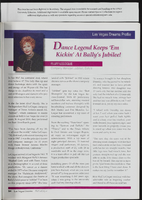

Transcript of interview with Helen Naugle by Irene Rostine, October 31, 1996
Prior to 1962, Helen Naugle had only visited Las Vegas once in her life while traveling from Idaho to California for a vacation with her husband and her boss. The group made a quick stop so her boss could interview for a position with EG&G and, as fate would have it, EG&G did not hire Helen’s boss. However, they did extend a job offer to Helen’s husband. A month later, Helen, her two daughters, and her husband became residents of Las Vegas, Nevada. Before moving to Nevada, Helen enjoyed singing in super clubs and performing on her radio show, “Melodies from Meadowland” and working for American Machine and Foundry. Upon her arrival in Las Vegas, Helen went to work for Bonanza Airlines before attending real estate school. In 1963, Helen opened her first office, Bruce Realty, and in 1965, she obtained her Broker’s license. She spent the next ten years selling general real estate. During this period, Helen was an active member of the Board of Realtors, as well as an early participant in the Board’s newly formed Women’s Council. Fate would strike again in Helen’s life while she was visiting her daughter at college in Arizona where she read an article in the Phoenix newspaper about a group of brokers who had formed a networking association to sell hotels and motels across the country. As a result of her initial contact with this association, Helen spent the next four decades selling hotels and motels throughout the State of Nevada, including Las Vegas, Elko, Tonopah, and Wells. She eventually became the first woman President of the American National Hotel-Motel Association. The cultural diversity of hotel and motel buyers would provide Helen with opportunities to travel the world and work with buyers from many different countries and cultural backgrounds. It also led to Helen’s membership in the FIABCI (International Real Estate Federation) and her Certified International Property Specialist and Federation of International Property Consultants certifications. Helen was also selected by the Association to represent the Air Force as “Innkeeper Evaluator” for one year. This honor took her to five Air Force bases in the United States and to Clark Air Force Base in the Philippines. During Helen’s career in hotel and motel real estate sales, she witnessed the transition from “mom-and-pop” American buyers to the influx of international buyers predominately from East India and Asia. The opportunities for helping repeat buyers and sellers gradually went away, as foreign buyers entered the market and tended to resell their properties to friends and family members from their own countries. During the latter part of her career, Helen found time to give back to the Las Vegas community through her volunteer work helping to establish the Scleroderma Foundation of Nevada. She also served on the Board of Directors of the Downtown Las Vegas Partnership where she focused on public safety in the area encompassing the Fremont Street Experience. Her work with both of these organizations allowed her to draw on her career experience for the benefit of others. Whether it was fate, or as Helen put it, she “just lucked into a lot of things,” one thing is certain - Helen Naugle was certainly a trail blazer for women in the hotel-motel niche of the real estate business, not only in Nevada, but across the nation.
Text
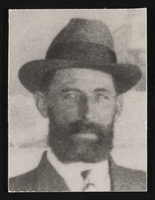
Portrait of Seymour Kimball Bradford: photographic print
Image