
Search Results

Nevada Library Notes
Nevada Library Notes, Vol. 1-4 issued by the Nevada State Library. Materials about the news of library activities and articles for publication by Nevada librarians. It also contains minutes of the 18th annual convention.
Text
Eddie Wright Jr. and Johnie B. Wright oral history interview
Oral history interview with Eddie Wright Jr. and Johnie B. Wright conducted by B. Leon Green on October 6, 2012; October 13, 2012; November 16, 2012; and November 28, 2012 for the African Americans in Las Vegas: a Collaborative Oral History Project. Wright and Wright Jr. discuss coming to Las Vegas, Nevada and their careers as a teacher/nursing aid and a ticket agent at the local Greyhound station, respectively.
Archival Collection
Laura Gunning oral history interview
Oral history interview with Laura Gunning conducted by Mike Martinez on March 5, 1981 for the Ralph Roske Oral History Project on Early Las Vegas. Gunning discusses her life in Las Vegas, Nevada. Gunning first talks about her family background, her church membership, education, and the minimum wage. She also talks about the Las Vegas Strip, the first businesses and markets in Las Vegas, change in climate, and family trips.
Archival Collection

Transcript of interview with Dorothy Ross Fletcher by Sharon Hildebrandt, June 26, 1975
On June 26, 1975, Sharon Hildebrandt interviewed Dorothy Ross Fletcher (born 1936 in Las Vegas, Nevada) about growing up in and living in Southern Nevada. Fletcher first talks about that various towns in which she lived while growing up before discussing the schools she attended. She also discusses the changes in schools, her involvement in politics, church activity, gambling as a recreational activity, and prominent visitors who came to Las Vegas. Fletcher also talks about living in Nevada during World War II, the atomic testing, environmental changes and extreme weather, and the social changes in Las Vegas. The latter part of the interview involves discussion of real estate, the introduction of air conditioning for cooling, changes on the Las Vegas Strip, recreational activities available to youth in Las Vegas and the increase in the nonnative population.
Text

Transcript of interview with Todd S. Polikoff by Barbara Tabach, August 30, 2016
In 2015, Todd S. Polikoff was named the President & Chief Executive Officer of the Jewish Federation of Las Vegas. (The organization is now known as Jewish Nevada). Todd is a graduate of Stockton University and earned his MBA at Cleveland State University. He has three children: Samuel, Shira and Jordan. Born in 1971 to a steelworker and hairdresser, Jack and Judy Polikoff, Todd grew up in Philadelphia, became a bar mitzvah there, and shocked his mother when he explained he was putting college on hold to move to Israel. In addition to stories about these life memories, Todd also traces his career path to decision-making to a meaningful trip to Moscow a where a defining moment helped him understand his own relationship with Judaism. To the time of this interview, Todd has invested over twenty years in leadership of Jewish Federation and AIPAC in states that include New Jersey, Delaware, Texas, Ohio and Nevada.
Text
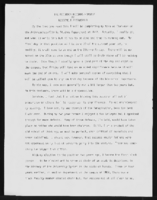
"The Recorder Records Himself": article draft by Roosevelt Fitzgerald
From the Roosevelt Fitzgerald Professional Papers (MS-01082) -- Drafts for the Las Vegas Sentinel Voice file. On the author's completion of term as Chair of UNLV Anthropology Department.
Text
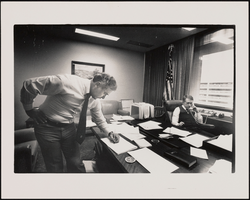
Reynaldo Martinez (Chief of Staff) and Senator Harry Reid together in Reid's office: black-and-white photographs
A former high school government teacher and championship baseball coach at Western High School, Reynaldo Martinez, Chief of Staff for former Congressman and now United States Senator from Nevada, Harry Reid, is one of a select few Americans, Hispanic and non-Hispanic, to work within the privileged confines of the United States Senate, this nation's highest elective body.
Image
Christopher C. Hudgins oral history interview
Oral history interview with Christopher C. Hudgins conducted by Claytee D. White on May 18, 2016 for the Boyer Early Las Vegas Oral History Project. Hudgins open his interview by discussing his upbringing in Virginia, his education, and the manual labor jobs he worked as a teenager. Hudgins then describes his introduction to American folk music and moving to Las Vegas, Nevada in 1976. Hudgins then recalls what the University of Nevada, Las Vegas (UNLV) was like in 1976 and how he became familiar with the city. Hudgins then discusses his career and scholarship while at UNLV as a chairman in the English department, and his interest in broadcasting. He then explains conflicts between the Board of Regents and the UNLV faculty, the expansion of UNLV related construction on Maryland Parkway, and his interest in becoming a dean. Hudgins describes his goals as dean of the liberal arts college, the challenges of implementing grants for liberal arts projects, and his views on college athletics. Lastly, Hudgins recalls attending a Nobel Prize ceremony as an invited guest of Harold Pinter, and his association with the City of Asylum organization.
Archival Collection

Transcript of interview with Florence McClure by Joanne Goodwin, January 24, 1996 & February 6, 1996
Florence McClure came to Las Vegas later in her life, but the state felt her presence and the community her contributions as if she were a native daughter. Introduced to the League of Women Voters in 1967, McClure met her political mentor Jean Ford and learned how to practice the core elements of democracy. She put those tools to work in a number of ways, however her participation in the creation of the Rape Crises Center and her advocacy for locating the women’s prison near Las Vegas are two of her long-lasting efforts. Florence Alberta Schilling was born in southern Illinois where she enjoyed the security of a tight-knit family and the independence to test her abilities growing up. She graduated from high school and attended the MacMurray College for Women at Jacksonville. With the attack on Pearl Harbor in 1941, she began a series of jobs working for the war effort. She moved to Ypsilanti, Michigan with a girlfriend to work at the Willow Run Army Airbase and then moved to Miami, Florida where she worked for the Provost Marshall in the Security and Intelligence Division. She met her husband, James McClure, at the time and they married in 1945. During the next several years, they raised a family and moved around the country and to Japan with the military. McClure came to Las Vegas in 1966 as part of her work in the hotel industry which she engaged in after her husband’s retirement from the military. She had worked in California and Miami Beach, but it was Burton Cohen in Los Angeles who invited her to join him in a move to Las Vegas to build the new Frontier Hotel and Casino. Following the completion of the Frontier, she moved to the Desert Inn with Cohen in 1967 and worked as the executive office manager. After a few years, she decided to leave the industry and complete her college education. She graduated from UNLV in 1971with a BA in Sociology with an emphasis on criminology. She was 50 years old. McClure had been a member of the League of Women Voters for a few years at that point and had learned the political process from Jean Ford and workshops on lobbying. She had numerous skills that were waiting to be tapped when she attended an informational meeting on the incidence of rape in the Las Vegas valley. From that meeting, a small group of individuals, including McClure, began the organization Community Action Against Rape (later renamed the Rape Crisis Center) in 1973. It was the first agency in the area devoted to serving individuals who had been assaulted and changing the laws on rape. The organization’s first office was set up in McClure’s home. Over the next decade, she worked to change attitudes and reshape policy by constantly raising the issues of sexual assault with police officers, emergency room doctors, judges, and legislators. Her role as an advocate took her into hospital emergency rooms and courtrooms to assist victims. It also took her to the state legislator to lobby repeatedly for a change in laws. During this period, journalist Jan Seagrave gave McClure the nickname “Hurricane Florence” - a fitting moniker that captured the force with which McClure attacked the issue. As a result of her efforts and those of the people with whom she worked, we now 1) recognize rape as a crime of assault; 2) forbid the sexual history of a rape victim from being used against her in court; and 3) recognize marital rape. In addition to learning about Florence McClure’s activities, the reader of this interview will gain information on the role of civic organizations like the League of Women Voters in engaging the voluntary efforts of women in the post-war years.
Text