
Search Results
Jewish religious education
Subject

Transcript of interview with Alexandar Grayson by David Glasco, March 15, 1981
On March 15, 1981, collector David Glasco interviewed card dealer, Alexander Grayson (born March 27th, 1952 in Durham, North Carolina) in his home in Las Vegas, Nevada. This interview covers the black experience in Las Vegas. Mr. Grayson also discusses prejudice, racism, education, and entertainment. Additionally, he recalls relocating to Las Vegas from North Carolina with his family when he was a child, as his father was in the Air Force.
Text
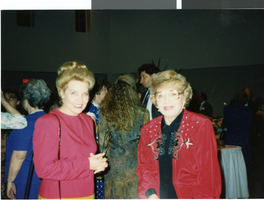
Photograph of Darlene Unrue and Edythe Katz at a University Library Society reception, Las Vegas, Nevada, circa 1991-1992
Image
An Interview with Todd Jones
Oral history interview with Todd Jones conducted by Claytee White on January 07, 2010 for the Voices of the Historic John S. Park neighborhood Oral History Project. Jones discusses moving to Las Vegas, Nevada in 1991 to become a professor of philosophy at the University of Nevada, Las Vegas and buying a home in the John S. Park Neighborhood.
Archival Collection
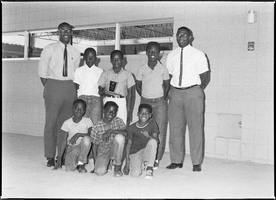
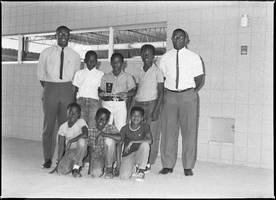

Transcript of interview with George Gilbert by Ruth Guidi, February 10, 1975
On February 10, 1975, Ruth Guidi interviewed George Gilbert (born 1931 in Southgate, California) about his life in Nevada. George first talks about his education in Las Vegas and his family background. He also talks about times during World War II, the shopping facilities available to those in Las Vegas, the casinos that existed, the churches that were built, and the Helldorado parades. The two also discuss social clubs, politics, the atomic testing, environmental and social changes, the Mormon Fort, Hoover Dam, and the first movie theaters.
Text
Yves Auriol oral history interview, 2024 June 21
Oral history interview with Yves Auriol conducted by Stefani Evans and Claytee D. White on June 21, 2024 for Game On! The Oral History of Las Vegas Sports project. In this interview, Auriol describes his childhood in Toulouse, France during World War II. The third oldest of seven children, Auriol learned the art of fencing from his brother. He graduated in 1955 from Lycee de Toulouse where he earned a master's degree as a fencing master from the Institute National du Sport in Paris. Eventually, he became a top fencing teacher in the sport, and in 1971 he followed his brother to the United States. Auriol served as head women's fencing coach at Notre Dame from 1985-95 and assumed head coaching responsibilities for the men's and women's programs in 1996. He developed into one of the most successful and respected coaches in the nation, and is a three-time Olympic coach. Digital audio, transcript, and photographs available.
Collection Name: Game On! The Oral History of Las Vegas Sports Interviews
Box/Folder: Digital File 00
Archival Component
King, Martha Pike, 1902-1994
teacher at Boulder City High School, 1940s-1950s; her headstone and the Boulder City High School profile say Martha Pike King
Person