
Search Results
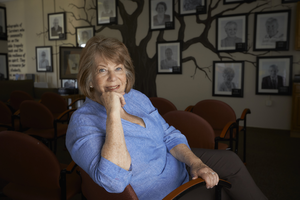
Photograph of Holocaust Resource Center's Myra Berkovits, Las Vegas, Nevada, May 31, 2016
Sperling Kronberg Mack Holocaust Resource Center of Las Vegas education specialist Myra Berkovits.
Image
Transcript of interviews with Al Levy by Cheryl Caples, February 23, 1979 and by Martha Zehnder, March 8, 1981
Part I: Interview with Al Levy by Cheryl Caples on February 23, 1979. At the time of this interview, Levy was serving on the city commission (now the Las Vegas City Council). He talks about growing up in Las Vegas and attending Las Vegas Grammar School (Fifth Street School) and Las Vegas High School. He mentions the Helldorado events, recreational activities, and raising a family in Las Vegas. Part II: Interview with Al Levy by Martha Zehnder on March 8, 1981. Levy recalls much of the same information as the previous interview, and again talks about his schooling and attending the University of Southern California. He returned to Las Vegas to assist his father with his grocery stores. Levy talks about the polio epidemic as the reason that children were not allowed to swim at public or hotel pools. He discusses his real estate firm, Levy Realty Company, his involvement in the community and the Jaycees (Junior Chamber of Commerce), and the booming hotel industry. Levy also discusses some city leaders he's known, including Mayor Gragson. He talks about his Jewish faith and having to go to Los Angeles to train for his bar mitzvah because there were no rabbis living in Las Vegas.
Text

Transcript of interview with Alma Athella Huffman by R.A. Grau, March 2, 1972
On March 2, 1972, collector R. A. Grau interviewed former Justice of the Peace, Alma Athella Huffman (born May 2nd, 1909 in Bunkerville, Nevada) in her daughter’s home in Las Vegas, Nevada. This interview covers the history of Southern Nevada. Alma also offers an in-depth description of early life in Bunkerville, Nevada.
Text
"Dummy Up": article draft by Roosevelt Fitzgerald
From the Roosevelt Fitzgerald Professional Papers (MS-01082) -- Drafts for the Las Vegas Sentinel Voice file. On rogue cops and maintaining silence about them.
Text
Dr. Lorne Seidman oral history interview
Oral history interview with Lorne Seidman conducted by Claytee D. White on November 14, 2006 for the UNLV @ 50 Oral History Project. In this interview, Lorne Seidman discusses moving to Las Vegas, Nevada in 1969 to teach business law at the University of Nevada, Las Vegas (UNLV). He also discusses becoming assistant general counsel and serving as attorney general of UNLV.
Archival Collection
Nancy Master oral history interview
Oral history interview with Nancy Master conducted by Claytee D. White on July 14, 2006 and for the UNLV @ 50 Oral history Project. In this interview Nancy Master discusses moving to Las Vegas, Nevada in 1980 and getting a job at the University of Nevada, Las Vegas (UNLV) in 1981. She also discusses teaching library skills, history, and political science at UNLV.
Archival Collection
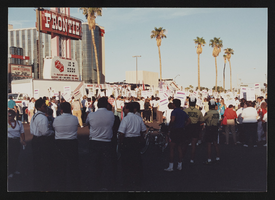
Photographs of Ironworkers and classified workers at Frontier Hotel, Culinary Union, Las Vegas (Nev.), 1991 August 07 (folder 1 of 1)
Culinary Union workers strike at the Frontier Hotel and Casino on August 7, 1991. Secretary-treasurer of the Culinary Workers Union, Jim Arnold, and civil rights activist, Jesse Jackson are shown speaking on stage. Photographs also show police officers and travel buses on site. A large banner is partly shown, reading "Welcome iron workers... iron workers of the state of California and vicinity including..." Protest signs read, "Conquering the Frontier, Culinary Local 226, Bartenders Local 165." The Frontier marquee is depicted and reads, "Welcome teachers & ironworkers, bottled beer 25 cents 2pm Aug. 7 .. 10"Arrangement note: Series I. Demonstrations, Subseries I.A. Frontier Strike Site name: Frontier Hotel and Casino
Image
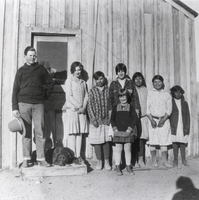
School and students at the R.O. Ranch, Nevada: photographic print
From the Nye County, Nevada Photograph Collection (PH-00221) -- Series V. Smoky Valley, Nevada and Round Mountain, Nevada -- Subseries V.D. Zaval Family (Smoky Valley and Round Mountain). Pete Rogers, Ms. Woodhouse (teacher), Ida Mike, Irene “Rene” Rogers Berg Zaval, Arlene (last name unknown) in front of Rene, Eva Johnson in the white dress, Ada Mike, and Ruth Mike (identified from left to right).
Image

Transcript of interview with Charlotte Conti by Charles Conti, March 20, 1978
On March 20, 1978, Charles Conti interviewed hairdresser and physical education instructor of St. Francis School, Charlotte Conti (born Charlotte Anne Easton on December 13, 1941 in Arkansas) at her home in Las Vegas, Nevada. During the interview Charlotte discusses occupations, Mormon Church activity, education, marriage and raising a family in Las Vegas. She then recalls the social significance and communal impact of the annual Helldorado Parade. She also discusses the overall growth and development of Las Vegas, Nevada, from 1953 to 1978.
Text